A Software Consultant Can Join Quickly. Did You Buy the Right Help?
By silverxis-admin6 min read
HealthCare.gov’s 2013 launch is a warning about buying technical work before the buyer has defined enough of the decision. The U.S. Government Accountability Office’s review found that the Centers for Medicare & Medicaid Services issued major development task orders while central requirements remained unknown. The problem was not merely a shortage of people writing software.
Employers face a similar purchasing choice whenever they ask for a software consultant, an extra developer or an entire delivery team. The right answer depends first on who can define the work and direct the person doing it. Buying capacity before answering that question turns an expertise purchase into a management problem.
Find the missing decision before filling the seat
A request for a senior developer sounds specific. But it can hide three very different needs. The organization may know exactly what to build and need additional hands. It may not know which architecture or vendor fits. Or it may want a partner to deliver a defined outcome while internal leadership stays focused elsewhere.
The GAO found that HealthCare.gov development proceeded while assumptions about participating states and potential enrollment were still unresolved. Contractors were asked to work within changing conditions. More production hours could not by themselves settle the buyer’s requirements or establish oversight. Those were responsibilities that had to be owned.
Start a purchasing conversation by identifying which decisions your employees are able to make. If a technical lead can assign tasks, prioritize changes and review work, an added specialist can be effective. If that lead cannot explain the solution, the first purchase should be expertise to define it.
Unknown requirements change the engagement
GAO documented key HealthCare.gov requirements that were unresolved when development work was ordered. Ask whether your request is for execution against a plan or help forming the plan
Compare the models by responsibility, not job titles
With staff augmentation, the specialist joins your team, process and tools. Your organization directs the backlog and remains responsible for the broader product decision. This model fits a capacity gap when the technical direction is already credible. It does not remove the need for a manager who can review the work.
IT consulting is different. You are buying diagnosis and a technical approach before committing to development. A good consulting scope should identify the problem, constraints, alternatives and decisions that the client must approve. Success is a sound basis for action, not a pile of advice that nobody owns.
A dedicated delivery team or fixed-scope project shifts a larger delivery obligation to the provider. That can be right when the client can define an outcome but does not want to supervise every task. It still requires a client decision-maker for policy, priority and acceptance. Outsourcing execution is not outsourcing accountability for what the business needs.
Who directs the work?
Choose the engagement by responsibility, not the job title.
1
IT Consulting
Define the technical approach before building.
Client approves the plan.
2
Staff Augmentation
Add a specialist to your existing team.
Client directs the work.
3
Dedicated Delivery
Provide a team to deliver the agreed scope.
Provider owns delivery.
Choose the engagement by who defines, directs and delivers the work.
One responsibility test
Who will choose the next task, accept the result and resolve a disputed requirement? If the answer is your team, price the management time along with the specialist.
Read proposals for what your team must supply
The commercial comparison should include more than hourly rates and promised start dates. Ask what materials, decisions, system access, reviewers and subject experts must be available from your side. A cheaper proposal that assumes continuous client guidance may cost more management time than a proposal with discovery and delivery ownership included.
HealthCare.gov illustrates the consequence of loose boundaries. GAO described confusion about who could authorize additional contractor spending and weaknesses in oversight. Those findings do not prove that one commercial engagement model always wins. They show why authority must be assigned before work and changes begin.
Request a first deliverable that exposes the arrangement. For a consultant, that may be a decision memo comparing technical options. For an augmented engineer, it may be a small feature reviewed in the existing team. For a delivery partner, it may be a documented scope with acceptance conditions. The artifact matters because it reveals what the parties think they purchased.
Make a fair start possible
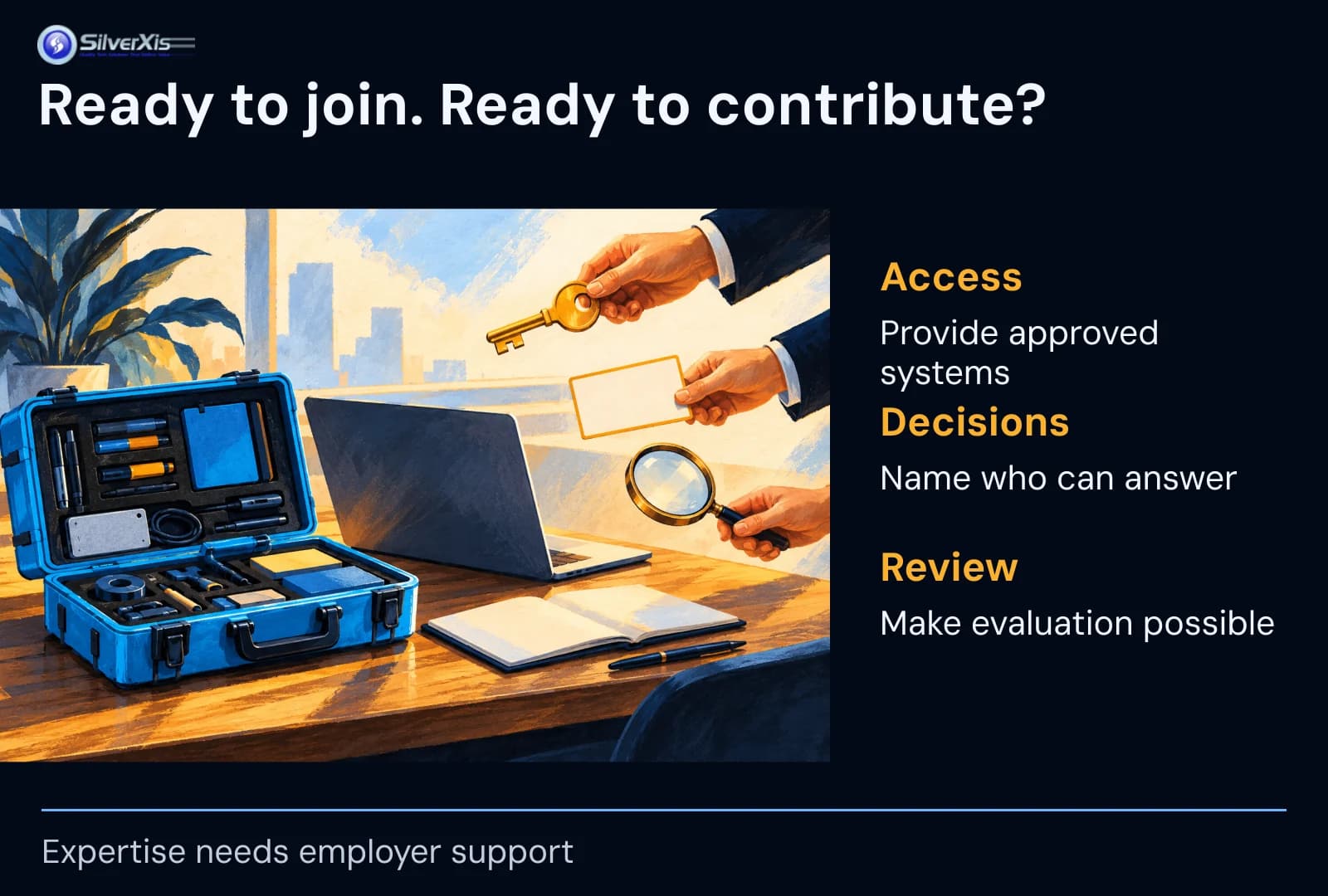
A well-matched specialist still needs usable access, context and a real task. Name the person who can resolve a blocker, book review time and explain the business rule behind the assignment. These are employer commitments. The provider should explain the specialist’s qualifications and the limits of the engagement just as plainly.
At SilverXis, staff augmentation is for clients ready to direct added talent, while IT consulting helps establish the approach when direction remains unsettled. Dedicated teams fit another shape of need. That distinction is not a sales hierarchy. It is a way to avoid paying an expert to wait for decisions nobody has made.
The proposal’s missing column
Alongside provider deliverables, list client decisions, named reviewers and required access. If those inputs have no owner, the proposed start date is incomplete.
HealthCare.gov’s lesson for an employer buying software help is to make the buyer’s work visible. Define the problem, decide who owns technical direction and select the engagement that fits that responsibility. A good start is not the earliest date a qualified person can log in. It is the first day their work has an accountable purpose.
Jeanie Jones is Senior Business Development Manager at SilverXis, focused on software consulting, technical specialists and development support. She helps businesses clarify their needs, evaluate engagement options and understand the value and responsibilities behind a proposal. Her perspective connects the expertise a business wants to buy with the work it needs to accomplish.
Have a project in mind?
Tell us what you're working on. We'll share how we'd approach it — no sales script.
No commitment required · Response within 24 hours · Free discovery call
We use cookies to understand how our site is used. Necessary cookies keep the site working. With your permission, we’d also use analytics cookies to improve it. You can change your mind anytime in Cookie settings. Cookie Policy