Being Found in AI Search Starts With Being Worth Finding
By silverxis-admin5 min read
On Oct. 15, 2026, Google announced changes that make links more prominent in AI Mode and AI Overviews. In Google’s own product announcement, the company described more inline links, tests of dedicated links to official sites and richer ways to explore articles. That is a specific product development, not proof that any individual business will receive more traffic.
For a marketing leader, the direction is encouraging and demanding at once. Search is becoming a conversation in which people can compare options before visiting a website. The job is not to trick an answer engine into naming your company. It is to make your expertise identifiable, your offer understandable and the next buyer decision easy to complete.
A citation is a doorway, not the sale
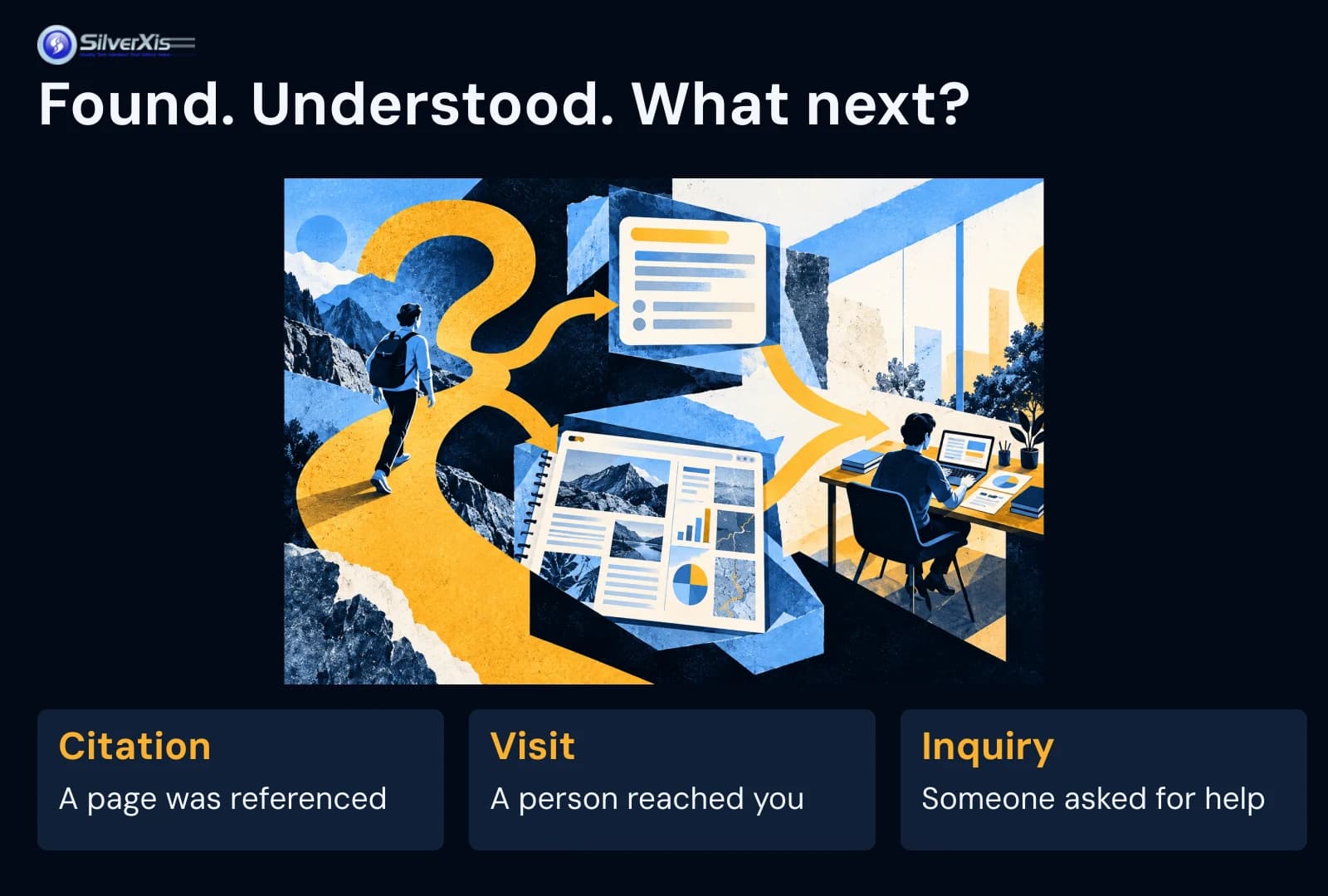
Traditional organic search often let marketers work backward from rankings to visits. AI search introduces additional steps. A business might be cited in an answer, a buyer might follow that citation, or the buyer might later search for the brand directly. Each event tells a different story. None by itself proves a qualified inquiry.
Google’s October update is expressly about helping people continue from an AI response to underlying pages. It does not guarantee that a prominent link will be displayed for every topic. Marketing teams should test what buyers actually see for their priority questions and record the observation date. Search interfaces change, and an undated screenshot is a poor substitute for sustained measurement.
The opportunity belongs to organizations whose pages contribute something an answer summary cannot replace: firsthand evidence, a bounded recommendation, a defensible explanation or a direct way to act. A generic article promising to improve efficiency is interchangeable. A page that names the problem, shows the relevant experience and explains the conditions of a service gives the visitor a reason to continue.
The change Google actually announced
Google said it was increasing inline link prominence and testing more prominent official-site links in AI search. It did not promise additional visits for any particular website.
Answer the buyer’s question before selling the method
A search strategy should begin with what a potential customer needs to decide. The query might be about cost, implementation responsibility, risk or which option fits the situation. The page should answer that question early, then give evidence and an unmistakable next step. Search engines do not create that substance. Marketing and subject experts do.
For a services company, that means explaining which work the client performs and which work the provider owns. It means naming limitations when they influence the purchase, not hiding them in a vague FAQ. It means showing the difference between a problem an existing platform can solve and one that actually warrants new software.
Google’s increased emphasis on routes from AI answers to source pages makes the destination experience more important, not less. Someone arriving after reading a summary has already received background information. The page must help with the next question, whether that is verifying expertise, comparing scope or requesting a specific assessment.
Evidence Signals
Citation
Your page was referenced
Visit
A person reached the site
Inquiry
A person asked for relevant help
These are different signals, not automatic conversions.
Three signals, three different meanings. Citation: Your page was referenced. Visit: A person reached the site. Inquiry: A person asked for relevant help.
Make the next question answerable
After the basic answer, can a buyer find scope, ownership, proof and a contact path without guessing which service matches the problem?.
Keep SEO at the center of AEO and GEO
SilverXis treats answer-engine optimization and generative-engine optimization as extensions of strong SEO, not replacements. Search visibility still depends on accessible pages, sound information architecture, relevant content and trustworthy business signals. AEO and GEO add attention to how specific questions are answered and how a brand is represented in AI experiences.
That position leads to work that can be inspected. Start with technical health, crawl and indexing barriers, page experience and the quality of the material itself. Align structured data with visible facts. Keep business identity consistent across the website and relevant profiles. Interview people doing the work so the content includes experience competitors cannot reproduce from a search snippet.
Do not sell a new file, an invented AI schema or mass-produced pages as a shortcut to guaranteed citations. Those claims distract from the task marketing leadership actually controls: communicating a differentiated offer in a form that people and systems can interpret.
Measure discovery against customer action
Track search impressions and clicks, but do not stop there. Record inquiry quality, booked conversations and the service pages that lead to actual buyer engagement. Add dated manual checks of priority AI answers to understand how the business is described and which sources appear. Keep observations separate from forecasts about future ranking behavior.
The October Google changes are a reminder to watch the buyer journey, not simply a dashboard. A more visible citation may help discovery. Whether it creates demand depends on the source page, the offer, the audience and the actions available when someone arrives.
Marketing leaders should also make a distinction between finding and choosing. Search might get a business into the conversation, but positioning, trust and experience determine whether the visitor believes it fits. Good design supports that judgment; it cannot replace the facts that earn it.
Three different measures
An AI mention is exposure. An organic click is a visit. A qualified inquiry is a commercial action. Report them separately before drawing conclusions about growth.
Google is building more paths from generated answers to the web. That is worth responding to with better source material, stronger service pages and honest measurement. The objective is not appearing everywhere. It is appearing credibly for the questions the business is equipped to answer and converting that attention into the right conversations.
Jason Dodge Marketing Leader | Growth & GTM Executive
Jason Dodge is Chief Marketing Officer at SilverXis. He works across industries on marketing strategy, positioning, messaging, design and digital growth. His responsibilities include SEO, AEO, GEO, content strategy, demand generation and performance measurement. He connects emerging marketing capabilities with the practical work of helping businesses communicate their value and attract relevant customers
Have a project in mind?
Tell us what you're working on. We'll share how we'd approach it — no sales script.
No commitment required · Response within 24 hours · Free discovery call
We use cookies to understand how our site is used. Necessary cookies keep the site working. With your permission, we’d also use analytics cookies to improve it. You can change your mind anytime in Cookie settings. Cookie Policy