How to Limit New Software Vendor Risk Without Stalling the Work
By silverxis-admin6 min read
A vendor can perform well for months and still expose an operational weakness through one routine change. On July 19, 2024, a CrowdStrike content configuration update caused crashes on affected Windows hosts. In its published preliminary post-incident review, CrowdStrike described an error that passed its validation process and the narrow time window in which affected systems received the update. This was a defective update, not a cyberattack.
New-vendor risk therefore cannot be settled by a strong proposal or an impressive onboarding meeting. The deeper commercial question is how a service relationship performs after change, uncertainty and recovery enter the picture. Buyers should judge the working relationship against evidence that arrives over time.
Define the service you must be able to continue
The first vendor review usually focuses on capabilities, cost and delivery dates. Those matter, but they leave out the work that cannot stop when a provider makes a mistake. Before entering an engagement, identify the service your customers or staff need, the operating dependencies behind it and how long an interruption can be tolerated.
CrowdStrike’s account distinguishes the affected Windows systems from hosts that did not receive the problematic update during the stated window. That distinction matters because risk depends on exposure, not a vague claim that an entire technology category failed. In vendor management, ask which environments and workflows rely on a service, not simply whether the supplier has a security checklist.
A buyer should name the critical path: the business process, the system that supports it, the vendor change that can interrupt it and the people responsible for recovery. This is more specific than asking whether the provider is reliable. It identifies where a relationship needs operational safeguards.
The affected window was specific
CrowdStrike identified impacted Windows hosts that received the update between 04:09 and 05:27 UTC on July 19, 2024. Define which parts of your own operation could be exposed to an equivalent change.
Review how change is introduced, not only delivered
For an ongoing software service, a handover is not the end of governance. The supplier continues changing code, configurations, access and infrastructure. Each change creates the possibility that something previously stable will behave differently. Ask the vendor how changes are tested, communicated, approved and reversed.
The CrowdStrike review reported that a validation defect allowed problematic content through before it reached affected systems. The lesson for other engagements is not that a specific testing tool will prevent every problem. It is that technical assurance needs an operating counterpart. Which updates need notice? What happens when a change produces an unexpected result? How quickly can affected users receive an explanation they can act on?
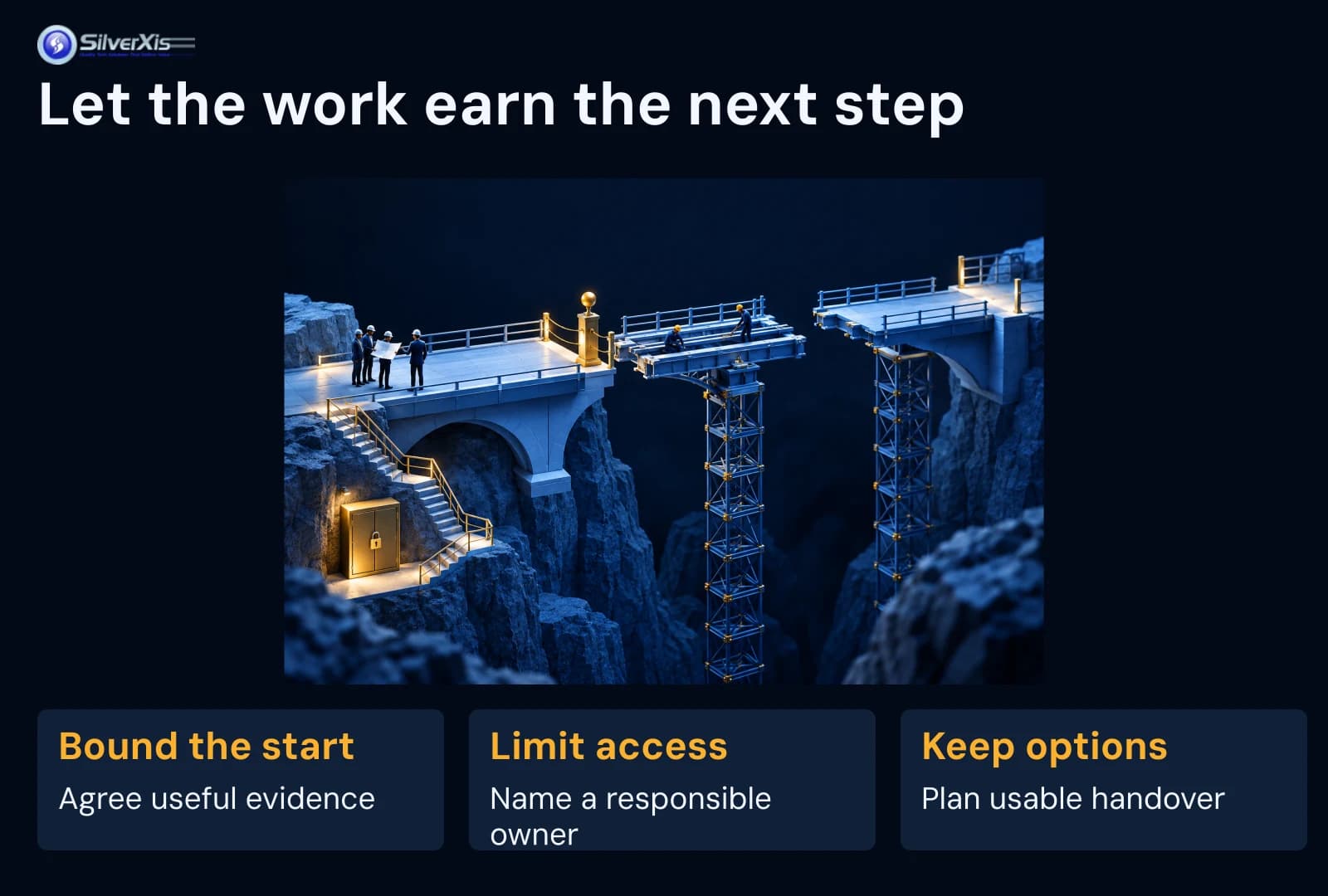
Early in a relationship, request a small, bounded commitment with observable acceptance criteria. Later, revisit those criteria using actual incidents, response records and the client’s experience of service. This creates an evidence trail rather than a cycle of reassurances at renewal time.
Four Safeguards
Four safeguards for a new relationship
Commitment
Define the first useful evidence
Access
Approve only what is needed
Continuity
Make the handover usable
Review
Decide before expanding
Four safeguards for a new relationship. Commitment: Define the first useful evidence. Access: Approve only what is needed. Continuity: Make the handover usable. Review: Decide before expanding.
Ask for the rollback owner
Who can authorize stopping a change, who contacts affected users and what does the client receive while recovery is underway? Assign people, not just an escalation email address.
Value changes as the relationship develops
Price is easy to compare at the beginning. Service value becomes more visible after the first change request, difficult conversation or unexpected demand. Review whether the provider identifies problems early, explains tradeoffs and helps the client’s team make decisions. That may justify continuing an engagement. Persistent missed commitments may justify narrowing, resetting or ending it.
A cheaper competitor’s proposal deserves the same scrutiny as the incumbent’s performance. Does its scope include testing, escalation, knowledge transfer and service continuity? What work moves back to the client’s employees? Savings on a contract line do not automatically translate into savings for the organization.
This ongoing review is a different discipline from selecting the original consultant. Selection asks which expertise and delivery model to buy. Ongoing account stewardship asks whether the original model is still producing the agreed business result. The right recommendation may be to continue without expanding, reduce scope or invest in a capability that has become necessary.
Plan a transition before needing one
Healthy vendor relationships should still be portable. Decide how configurations, documentation, credentials, work history and unresolved issues will be transferred if a service moves to another provider or returns in-house. The purpose is continuity, not distrust. A client who understands the exit path can make a better decision about staying.
After the CrowdStrike incident, organizations had to recover affected systems. An enterprise should use any such interruption to test its own recovery ownership and communications, not merely demand stronger promises from the supplier. Some controls sit with the provider, while resilience across the business remains a shared responsibility.
SilverXis’s approach is to define delivery responsibilities and operating tradeoffs before development, review working results as work proceeds and stage software transitions rather than force a disruptive switch. In an account relationship, those habits also create evidence for deciding when to maintain, adjust or transition a service.
Review for a decision, not an upsell
At each service review, record the promised outcome, observed result, new dependency and recommendation. “Continue unchanged” should be a valid answer.
The lesson of CrowdStrike’s update is not to avoid every supplier capable of making a mistake. It is to buy with the future operating relationship in view. Vendor risk falls when changes are visible, recovery has an owner and service value can be examined without turning every review into a sales pitch.
Caleb OdomChris Di Maio Senior Client Engagement & Account Growth Leader
Chris Di Maio leads client engagement and account growth conversations at SilverXis across software, technical talent and digital marketing services. His work focuses on understanding client priorities, evaluating service value and identifying changing needs. He brings a commercial perspective to partner relationships, investment tradeoffs and the signals that warrant reviewing an existing approach.
Have a project in mind?
Tell us what you're working on. We'll share how we'd approach it — no sales script.
No commitment required · Response within 24 hours · Free discovery call
We use cookies to understand how our site is used. Necessary cookies keep the site working. With your permission, we’d also use analytics cookies to improve it. You can change your mind anytime in Cookie settings. Cookie Policy