The Most Useful Software Demo Tests the Assumption Behind the Purchase
By silverxis-admin6 min read
The Internal Revenue Service did not begin its 2024 Direct File pilot by promising a full-service tax platform for every taxpayer. Its first release was limited, tested and expanded gradually. The IRS account of that pilot reports that 140,803 taxpayers filed accepted returns through the system in 12 states. The interesting buying lesson is not the size of the software. It is how the scope made a decision testable.
A custom software purchase should follow the same logic. Before judging an attractive demo, decide which assumption could make the whole investment unwise. Then ask for evidence that addresses that assumption, rather than a smooth tour of features everyone already expects.
Separate the business problem from the requested product
Buyers often begin with a solution name: portal, scheduling app, internal dashboard or new platform. The label sounds actionable, but it conceals the work the business is trying to change. A proper decision asks who has the problem, what current alternatives cost and why an existing product cannot solve it adequately.
Direct File began with a defined group of users and supported tax situations. People outside that scope were directed toward other filing options. The pilot therefore tested a limited service rather than treating every taxpayer’s circumstances as a launch requirement. That boundary made feedback interpretable.
In commercial software, the equivalent is not automatically a pilot available to every customer. It might be one department, one transaction type or one integration. The principle is to isolate a business condition that the investment depends on. A demo proves only what it actually exercises.
Scope was part of the evidence
IRS Direct File served eligible taxpayers in 12 states during its 2024 pilot. People whose situations were outside scope were directed to other filing paths.
Choose the test that could change the purchase
Ask three questions before commissioning a proof of concept. Which belief are we trying to verify? What observation would count against it? Who has the authority to change the purchase after seeing the result? If those answers are missing, a prototype can become a sales demonstration with a development invoice attached.
The IRS used an eligibility checker, controlled access and a gradual expansion during its pilot. Its published results distinguish interest from completed filing: more than 3.3 million people started checking eligibility, 423,450 logged in and 140,803 submitted accepted returns. Those are different behaviors. A software buyer should make the same distinction between curiosity, participation and the outcome the application exists to produce.
For an internal application, successful evidence may be that a representative user completes a high-friction task without rebuilding the same spreadsheet. For an integration, it may be that the target system can exchange the required records with acceptable error handling. Neither test requires a polished visual interface to be informative.
Match the question to the evidence
Need
Does the task matter to users?
Use
Can people complete the task?
Dependency
Can the required connection work?
Decision
What should change or proceed?
A passed test supports only its own conclusion.
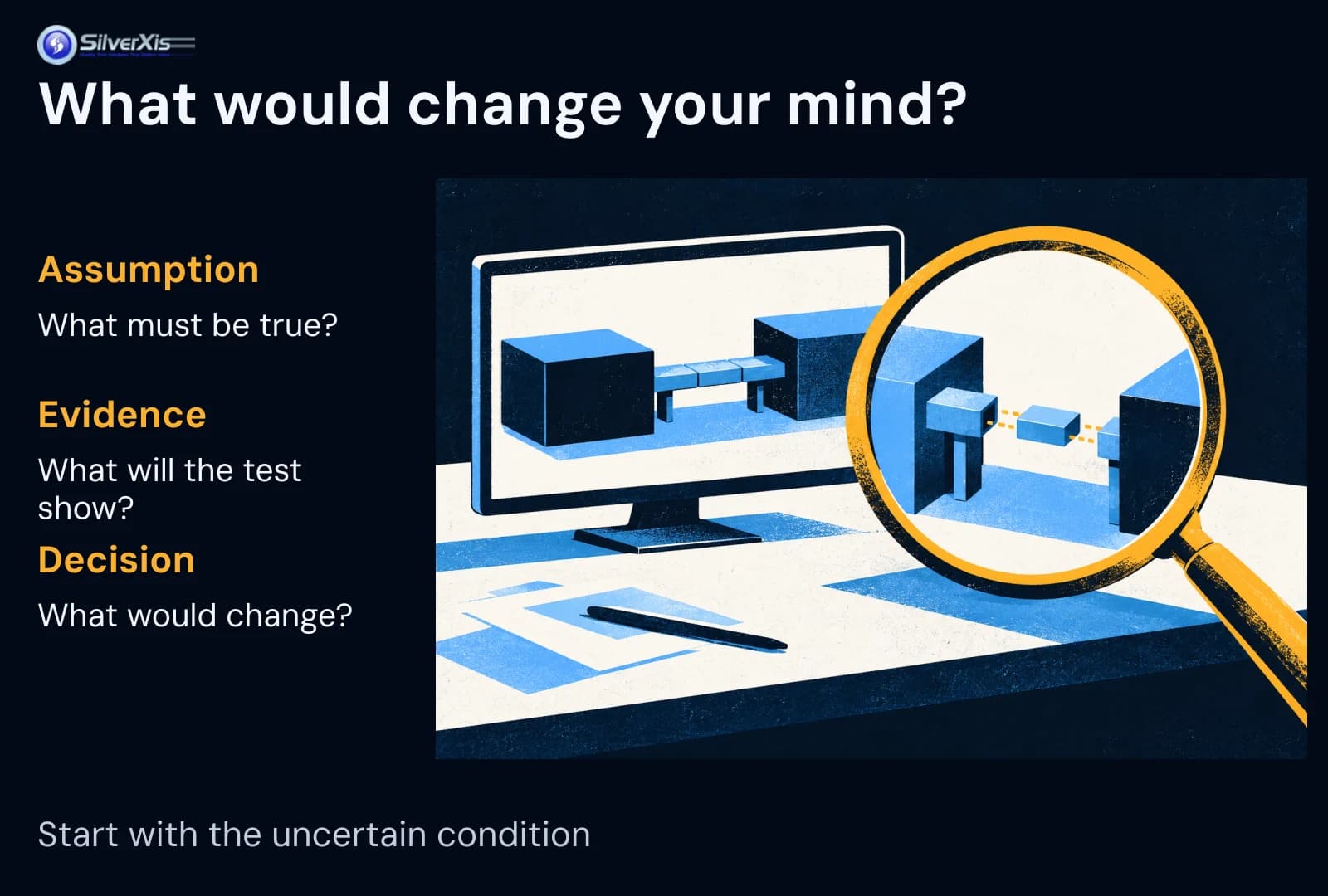
Match the question to the evidence. Need: Does the task matter to users?. Use: Can people complete the task?. Dependency: Can the required connection work?. Decision: What should change or proceed?.
A funnel is not a completion count
In the IRS pilot, people who checked eligibility, logged in and filed an accepted return were counted separately. Define the equivalent completion event before testing your software.
Invite the people who inherit the consequences
A purchasing group may include commercial leadership, information technology, finance, operations and employees who will do the work. Each sees a different failure mode. Finance asks whether the benefit warrants the cost. A technical lead asks whether the integration is feasible. A frontline user sees the hidden steps skipped in a tidy presentation.
The Direct File pilot had to serve taxpayers while addressing the boundaries between federal filing and state systems. That is a useful reminder that a product journey frequently crosses systems and institutions. The question is not simply whether the first screen works. It is whether a person can complete the promised task with the surrounding dependencies intact.
Bring those stakeholders into an early review while changes remain cheap. Give each a defined decision, not an invitation to add unrelated features. Ask operations to validate task completion, technology to test a critical dependency and the buyer to judge whether the resulting evidence justifies the next stage.
Use the result to choose build, configure or stop
Sometimes the evidence points away from custom development. An existing platform may cover the true requirement at a lower total cost. Configuration or integration might eliminate the troublesome manual step. The buyer should be allowed to reach that conclusion without treating discovery as a failed sale.
SilverXis’s position is to begin with the business problem, recommend an existing tool when it fits and build custom software when a distinctive process genuinely requires it. Scope and architecture precede development, with tradeoffs and cost visible before the build. Working software is reviewed at the end of each sprint.
Write the stop condition first
What result would tell the buying group to use an existing platform, narrow the proposed build or cancel it? If no result could change the decision, it is not a decision test.
Direct File’s first season is a historical example of using a bounded service to learn. It does not settle the politics or future of that government program, and it cannot dictate a private company’s economics. It shows the discipline of separating a promising product from demonstrated use. Informed buyers purchase evidence before they purchase the full ambition.
To test the assumption behind a custom application, get a SilverXis Build Plan and specify the decision the initial scope must answer.
About the Author
Caleb Odom Director of Partnerships (SilverXis)
Caleb Odom is Director of Partnerships at SilverXis. His business-development work spans custom software, IT staff augmentation and digital marketing. He helps organizations examine their needs, understand dependencies and evaluate potential approaches. His perspective centers on how stakeholders make buying decisions and connect a service investment to a useful business outcome.
Have a project in mind?
Tell us what you're working on. We'll share how we'd approach it — no sales script.
No commitment required · Response within 24 hours · Free discovery call
We use cookies to understand how our site is used. Necessary cookies keep the site working. With your permission, we’d also use analytics cookies to improve it. You can change your mind anytime in Cookie settings. Cookie Policy