Why a Long Software Skills List Can Hide the Person You Need
By Sanskruti Tripathi6 min read
GitLab tells its interviewers to review the actual role description, align with the hiring manager on competencies and use an interview kit with a scorecard. These steps appear in GitLab’s published interview guidance. They offer a counterweight to a familiar recruiting problem: a software vacancy that lists every tool anyone on the team has ever touched.
A long skills list can make a technical role appear precise while hiding what the new person must accomplish. Recruiters need evidence of work, not just recognition of product names. Hiring teams get better shortlists when they define the first assignment and the conditions under which someone will succeed.
Describe the assignment before the stack
The first question in a role intake should be about the work. Is this person stabilizing an application, building a new feature, investigating an integration or helping an established team deliver faster? Each assignment suggests different evidence. The language of the job ad should reflect that responsibility.
Frameworks, cloud platforms and databases still matter. But when every technology becomes mandatory, the description stops distinguishing essential experience from something a capable person can learn. A candidate who has solved an analogous problem may be ruled out before anyone hears what they did.
GitLab’s guidance directs interviewers to read the job description and ask the hiring manager about any uncertainty in scope. That is a recruiting control, not administrative tidiness. If interviewers are confused about the role, candidates will receive mixed signals and scorecards will become a collection of personal preferences.
GitLab starts with role scope
Its interviewer guidance calls for understanding the job description and aligning on competencies before evaluating candidates. Resolve disagreements before the interview schedule fills.
Turn requirements into evidence requests
Ask a hiring manager to name the two or three outcomes that would define success in the opening months. For each, identify the experience a candidate could describe or demonstrate. Instead of “five years of framework X,” ask for an example of maintaining or changing a comparable system under a constraint that matters to your team.
A strong project story includes the problem, the candidate’s own responsibility, the tradeoff, the collaboration and the result they can substantiate. It also distinguishes being near a technology from making decisions with it. A candidate should be able to say which part they owned, without taking credit for the entire team’s output.
GitLab’s interview materials include role-related competencies and a scorecard for the interviewer. That structure gives hiring teams a way to compare evidence across candidates. It works best when the criteria have been chosen before the first meeting rather than invented to explain a favorite applicant afterward.
Turn the assignment into a useful brief
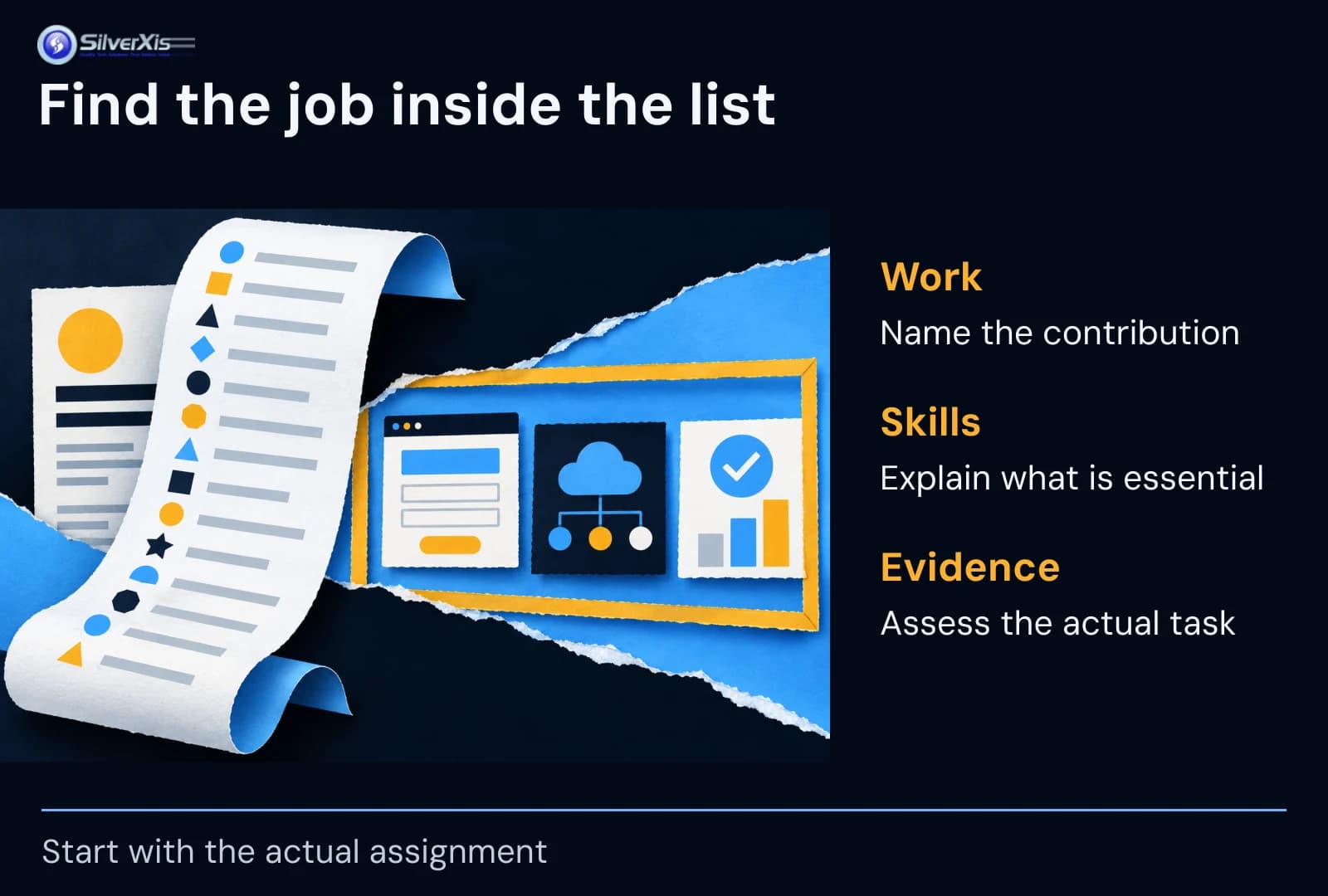
Work
Name the contribution required
Skills
Separate essentials and preferences
Support
Confirm direction and review
Evidence
Assess what the work requires
Match the question to the evidence. Need: Does the task matter to users?. Use: Can people complete the task?. Dependency: Can the required connection work?. Decision: What should change or proceed?.
Replace a tool count with a project question
Ask: What did you personally change, who reviewed it and what would you handle differently? Follow-up questions reveal contribution that a keyword match cannot.
Explain the working conditions honestly
Candidate fit is not limited to technical ability. A specialist may be excellent at independent investigation but unhappy in a highly collaborative support role. Another may excel in a product team but not have the schedule overlap the assignment demands. Neither result makes the candidate weak. It makes the brief incomplete when the working conditions are missing.
Recruiters should establish the first task, collaboration expectations, time-zone overlap and the person available for questions before recommending a start date. Candidates should learn whether they will join the client’s tools and rituals or work through an external delivery lead. That distinction influences both performance and willingness to accept.
The GitLab example shows why a structured interview process is a team commitment. The hiring manager, recruiter and interviewer must share the same understanding of what is being assessed. An excellent interview does not rescue an undefined assignment.
Protect the first week
Recruiting does not end when the candidate accepts. A strong start requires approved access, a named manager and work that tests the contribution promised in the brief. The first week should not depend on the new person discovering who can answer every question by accident.
For consultants joining an existing engineering team, the immediate goal is usually to complete a real, reviewable piece of work inside the team’s process. That first contribution reveals whether the skill assessment and working conditions were accurate. If the task is blocked, diagnose the missing input before deciding the consultant was a poor match.
SilverXis’s recruiting position is to match the candidate to the actual brief, assessing ability, relevant experience and organizational fit before a client interview. Its staff augmentation model places specialists inside the client’s process while the client directs the work. That makes a precise assignment and an honest description of collaboration essential.
Ask one first-week question
Which real task can the new person complete or advance, and who is responsible for reviewing it? An answer tests whether the role is ready for a candidate.
A recruiter adds value by preventing a mismatch before it becomes an expensive interview cycle. GitLab’s published emphasis on scope and competencies provides a documented example of that discipline. The strongest brief describes the contribution, tells candidates how the work happens and gives interviewers shared evidence to judge.
Steve Flad is Staffing and Fulfilment Manager at SilverXis, working with technical candidates, software consultants and hiring teams. His recruiting perspective connects project requirements with relevant experience, candidate fit and placement readiness. He focuses on the practical details that help both sides understand an assignment, including responsibilities, collaboration, expectations and onboarding.
Have a project in mind?
Tell us what you're working on. We'll share how we'd approach it — no sales script.
No commitment required · Response within 24 hours · Free discovery call
We use cookies to understand how our site is used. Necessary cookies keep the site working. With your permission, we’d also use analytics cookies to improve it. You can change your mind anytime in Cookie settings. Cookie Policy