What Klarna’s AI Support Shows About Reviewing a Technology Engagement
By Christopher Di Maio8 min read
Klarna reports that its AI assistant handled 80% of customer service chats in 2025 while every customer could still reach a person. The lesson for a technology engagement is to review the customer outcome, including the requests automation could not finish, before agreeing to expand the service.
Eighty percent of Klarna’s customer service chats were handled by its AI assistant during 2025, according to the company’s annual report on Form 20-F. That’s a substantial operating change. The more revealing detail for anyone managing a technology relationship is that Klarna also said customers could still choose a human representative. Efficiency and customer choice were part of the same service design.
In its annual report on Form 20-F for 2025, filed with the SEC on Feb. 26, 2026, Klarna described its AI assistant, reported its own service and cost measures and said it continues to offer all customers the option of a human representative. Klarna calls that a dual-track approach. Those results belong to Klarna and rest on its internal chat logs and surveys. They aren’t a benchmark for another company, and they don’t prove that buying more AI will improve every service operation. They show the kind of evidence that deserves attention when an organization reviews an expanding engagement.
What should a technology account review measure besides automation?
Technology providers often lead a quarterly review with what was delivered and how much was automated. A client has a different question: Did this improve the experience we’re responsible for? A high volume of automated interactions is one part of the answer. You also need to know what happened to the conversations that couldn’t be completed that way.
Klarna’s disclosure reports that its AI assistant handled most chats and that it continued to offer human assistance. It also reports no drop in consumer satisfaction. The important lesson for a business development or account growth conversation isn’t to copy those figures. It’s to review the system from the customer’s side, not only the provider’s delivery report.
What does the customer do when the automated response doesn’t fit? Is the transfer to a person straightforward? Are the exceptions visible to the team responsible for improving the service? Without those answers, a provider can claim an impressive automation rate while the buyer is left wondering about the quality of the remaining interactions.
A better account review: Ask what percentage of requests were resolved as intended, which requests needed a person and what customers had to repeat.
Expand the part that works, not the invoice
An existing engagement creates its own momentum. The technology is running, the people know each other and the next phase sounds like a natural step. But familiarity is not evidence that the next investment is needed. Before you agree to expand a service, ask your provider to name a specific problem that has become more important or more solvable.
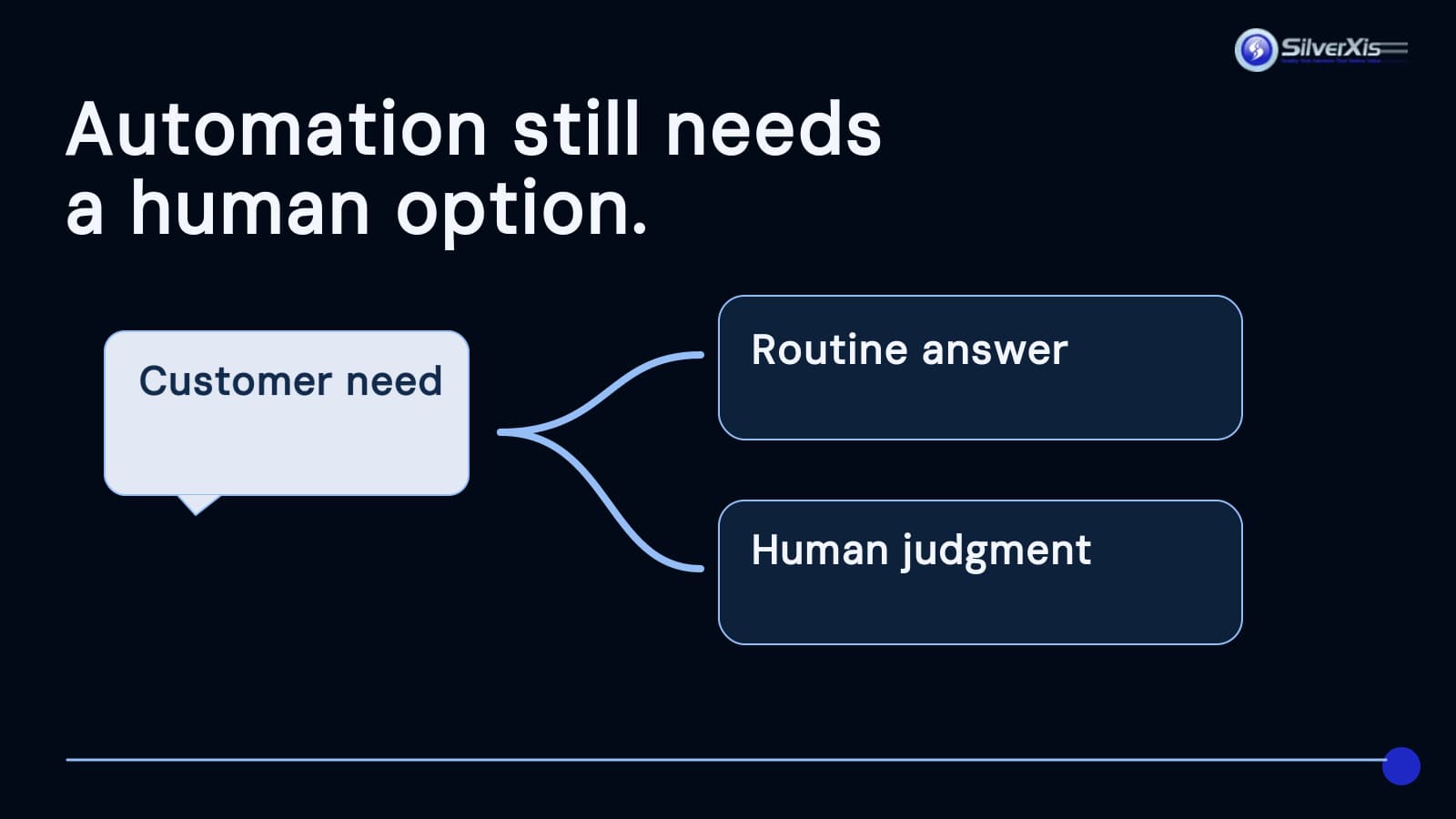
Klarna’s reported approach combines automated capacity with human support. It gives us a concrete way to think about service design as a set of choices rather than a race to remove manual work. A business might learn that routine status questions are appropriate for automation while disputed charges or complex account questions need a different path. The right mix has to come from that business’s own customers and obligations.
For the account team, the first task is to separate what the current service handles well from what is still causing friction. If the remaining problem is poor information in a knowledge base, adding another AI feature won’t necessarily fix it. If a handoff is slow because nobody owns it, the next investment may be a process decision. If a repeated request is both well understood and frequent, expanding the automation may make sense.
Measure customer resolution
before buying more capacity.
Resolved
A real answer
Escalated
A smooth handoff
Unanswered
A reason to improve
A client account review should examine the customer outcome, not just throughput.
When should a provider recommend no expansion?
A strong commercial relationship should make it possible to recommend no expansion. That sounds unusual in a sales conversation, but it protects the credibility of future recommendations. A service review should be free to end in keep, change or exit, a decision I’ve written about for vendor renewals. The evidence should drive the direction.
I would ask for three things before proposing a larger technology commitment. First, a plain description of the customer problem that remains. Second, a baseline that the client agrees represents the current experience. Third, a small change whose result can be checked before anyone signs up for a broader rollout. The steps don’t need a complex committee. They need someone who owns the decision.
The expansion test: If the proposed next phase succeeds, what will customers experience differently, and how will the client know?
Klarna’s filing puts both facts side by side. It reports gains in service automation and states that every customer can still reach a person. Klarna presents that human option as part of its operating approach. That pairing is worth copying in an account review: report what automation handled and what people still need to handle.
A productive review can strengthen the relationship without a sale
Clients should be able to ask hard questions about the work they’re paying for. Has the service met its purpose? Are the remaining problems worth solving now? Is the team handling exceptions well? A partner that answers those questions without turning every answer into a proposal will have a more credible position when a genuine opportunity appears.
At SilverXis, we favor focused AI work that starts with a defined task, fits the existing applications and expands only when the business sees the reason. We don’t need to claim that every interaction belongs in a chatbot. We need to understand which interactions warrant one and how people stay involved when the situation calls for judgment.
For the next review meeting: Put one unresolved customer situation on the agenda. Decide whether the answer is better information, a better handoff or additional technology.
If AI is part of that decision, book a free 30-minute discovery call with SilverXis to review one service task and the conditions that would justify expanding it.
How much of Klarna’s customer service does AI handle?
Klarna’s annual report on Form 20-F for 2025 says its AI assistant handled 80% of customer service chats in the year ended Dec. 31, 2025, based on its chat log data, with no drop in consumer satisfaction in its internal surveys.
Can Klarna customers still talk to a person?
Yes. Klarna says it continues to offer all customers the option of a human representative and calls this a dual-track approach.
What should a technology account review include?
The share of requests resolved as intended, the requests that needed a person, what customers had to repeat and one unresolved customer situation. Then decide whether the fix is better information, a better handoff or more technology.
About the Author
Christopher Di Maio Senior Client Engagement & Account Growth Leader
Christopher Di Maio leads client engagement and account growth conversations at SilverXis across software, technical talent and digital marketing services. His work focuses on understanding client priorities, evaluating service value and identifying changing needs. He brings a commercial perspective to partner relationships, investment tradeoffs and the signals that warrant reviewing an existing approach.
No commitment required · Response within 24 hours · Free discovery call
We use cookies to understand how our site is used. Necessary cookies keep the site working. With your permission, we’d also use analytics cookies to improve it. You can change your mind anytime in Cookie settings. Cookie Policy