A Vendor Review Should Measure Resilience, Not Just Renewal Price
By Christopher Di Maio7 min read
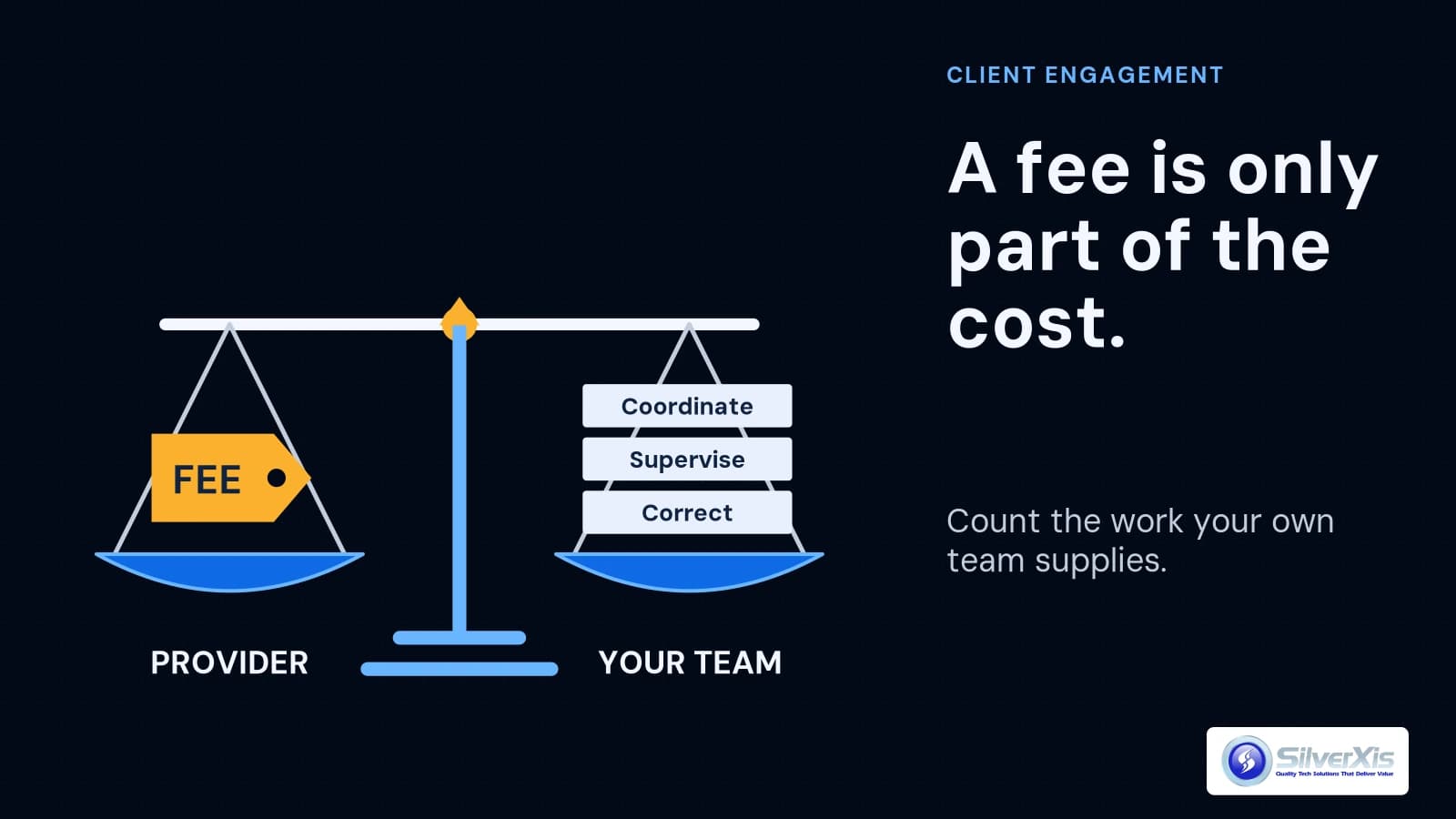
The fee on a renewal proposal is easy to compare. The time your own team spends making the service work is much easier to overlook. Before you call one proposal a better deal, put both on the table. A lower fee isn’t much help if the same unresolved work keeps landing with your employees.
A service relationship should hold up when priorities change, the main contact is away or the workload shifts. That’s what resilience means in an account review. You’re checking whether the arrangement still works for both sides, not simply whether the provider offered a discount for another year.
Start with what you need now
Go back to why you bought the service. Is that still the job you need done? A team brought in to accelerate a project may now be supporting a stable application. Or a narrow assignment may have grown into something much larger without anyone updating the scope. Neither situation automatically means the provider has performed badly.
Compare today’s need with the responsibilities you’ve agreed on. If they no longer match, you have a choice to make: reshape the service, reduce it or find a different arrangement. Asking everyone to work harder won’t fix a model that no longer fits.
Include the favors that have quietly become routine. Both sides need to know whether that extra work belongs in the service, should stop or should come back to your team. Leaving it undefined makes planning difficult and puts too much weight on someone’s willingness to help.
Which favor has become a job?
What recurring task would stop if your usual contact stopped doing it as a favor? Decide where that work belongs.
Count your team’s part of the work
Look at the time your employees spend explaining, supervising, checking and correcting the work. Some of that involvement belongs with you. The review isn’t a search for a provider who needs no input. It’s a check on whether your team is supplying more time and attention than you intended.
A specialist working under your technical lead is a different purchase from a provider responsible for an agreed deliverable. SilverXis makes that distinction between staff augmentation, where you direct the work, and arrangements with defined delivery responsibility. Two fees aren’t comparable until you know which responsibilities come with each.
Ask what’s behind a lower price. Does it assume more coordination or review from your team? Include that effort before deciding you’ve found a saving. Equally, don’t pay someone to manage work you’re ready and willing to direct yourself. The right arrangement depends on what you need to hand over.
DECISION GUIDE
Give the review a real decision.
01
Service still fits
KEEP the arrangement
02
Need or responsibility changed
CHANGE the model
03
Value is no longer supported
PLAN AN EXIT
Every review should end in keep, change or exit
Look past the person who always makes it work
A strong relationship with your main contact matters. But another authorized person should be able to pick up the account without starting from scratch. Can they find the current priorities, open issues and commitments? That’s better evidence of continuity than a promise that the usual contact will always be available.
You don’t need to stage a crisis to find out. Look at a recent everyday problem. Who took responsibility? Who needed the answer? Where was the resolution recorded? Those details show whether the service can keep working when someone else has to step in.
Ask the second contact
Can another authorized person explain the next commitment and why it was made without first calling the account lead?
Try a focused improvement before a bigger contract
A good review should leave room for less work, different work or no extra spending. Before discussing expansion, agree on the problem it would solve and what improvement would look like. Buying more of a service isn’t an answer when the existing responsibilities are still confused.
For a problem you can correct, choose one person to own the change, a result you can observe and a date to review it. Keep the test small enough to learn from. Changing the scope, people and reporting all at once makes it harder to tell what helped.
Give an existing partner a fair chance when the evidence supports it. Familiarity is worth something, but it doesn’t excuse poor performance. The same discipline applies to a replacement: enthusiasm during a sales conversation isn’t proof of future results. Ask both providers to explain how the arrangement will work.
Make a decision instead of letting the renewal happen
Keep the service when the outcome, responsibilities and effort still fit. Change it when the work or the way you need it managed has shifted. Plan an exit when the evidence no longer supports staying. Your review should make one of those choices easier to explain.
Would you buy it this way today?
Which responsibility would you define differently in a new agreement? Resolve that difference before renewing the old one unchanged.
Include the effort of switching providers, but don’t let it become a reason to postpone the decision indefinitely. A relationship earns its renewal by meeting the need you have now. A discount can be welcome. It just shouldn’t distract you from the work both sides still need to sort out.
For another perspective on your service arrangement, book SilverXis’s Free 30-Minute Discovery Call. Describe what you need now and the responsibility your team is carrying that the current proposal doesn’t address.
About the Author
Christopher Di Maio Senior Client Engagement & Account Growth Leader
Christopher Di Maio leads client engagement and account growth conversations at SilverXis across software, technical talent and digital marketing services. His work focuses on understanding client priorities, evaluating service value and identifying changing needs. He brings a commercial perspective to partner relationships, investment tradeoffs and the signals that warrant reviewing an existing approach.
No commitment required · Response within 24 hours · Free discovery call
We use cookies to understand how our site is used. Necessary cookies keep the site working. With your permission, we’d also use analytics cookies to improve it. You can change your mind anytime in Cookie settings. Cookie Policy