A Customer Portal Is a Buying Decision About People, Not Pages
By Caleb Odom8 min read
A customer portal is a decision about who owns the records, statuses and exceptions behind the screen. Before approving one, pick one recurring customer request, name the owner of each record it touches and decide how exceptions are handled. Then compare proposals on whether they cover that whole journey.
Who owns the answer when a customer submits something online and wants to know what happens next? That’s the question a technology buyer needs to settle before approving a portal. A polished interface won’t solve a process whose ownership is still being debated.
The U.S. Department of State offers a grounded example. Its official online passport renewal service lets eligible citizens apply online, pay the required fee and receive updates as an application moves through processing. The public instructions also explain when people aren’t eligible, what happens after submission and how to respond when the department needs more information. The visible service is only one part of a larger chain of decisions.
In business development, a prospect may begin with a request for a customer portal. Sometimes that’s exactly the right project. But the phrase hides several decisions. What is the customer trying to accomplish? Which records are needed? Who maintains them? What should happen when the request falls outside the standard path?
The passport renewal experience illustrates why those questions belong in the buying conversation. Applicants confirm they meet the eligibility requirements before they start. The customer is told what information to prepare. After submission, status messages describe progress and requests for additional information. That sequence shows the public-facing responsibilities the service must support.
For a commercial business, those responsibilities might sit across sales, customer support, finance and operations. Calling the entire effort a web project can hide the people who need to approve the workflow. Buying the interface before resolving the process makes a later change request almost inevitable. The same problem shows up when cross-team dependencies are left unresolved before a software purchase.
A portal readiness question: If the customer sees the wrong status, which team owns the correction and which system holds the authoritative record?
Who should be in the first customer portal meeting?
A salesperson can describe the desired experience. A developer can explain ways to build it. Neither should decide alone which internal system has the last word on a customer’s account or transaction. That belongs to the people who operate the process and are accountable for the information.
The Department of State’s public process separates the applicant’s actions from the agency’s processing and follow-up. It’s an instructive distinction for a technology proposal. A portal can display status, but somebody must define what the status means, when it changes and how exceptions are resolved. If those definitions are missing, the software team will end up making business decisions by default.
This is why I prefer to bring the record owner into discovery early. They may point out an existing process that works, a data field that cannot be trusted or a condition that requires a human review. That information can save an organization from purchasing features that won’t address the actual friction.
The meeting that prevents rework: Invite the person responsible for the source record, the person who handles exceptions and the person accountable for the customer experience.
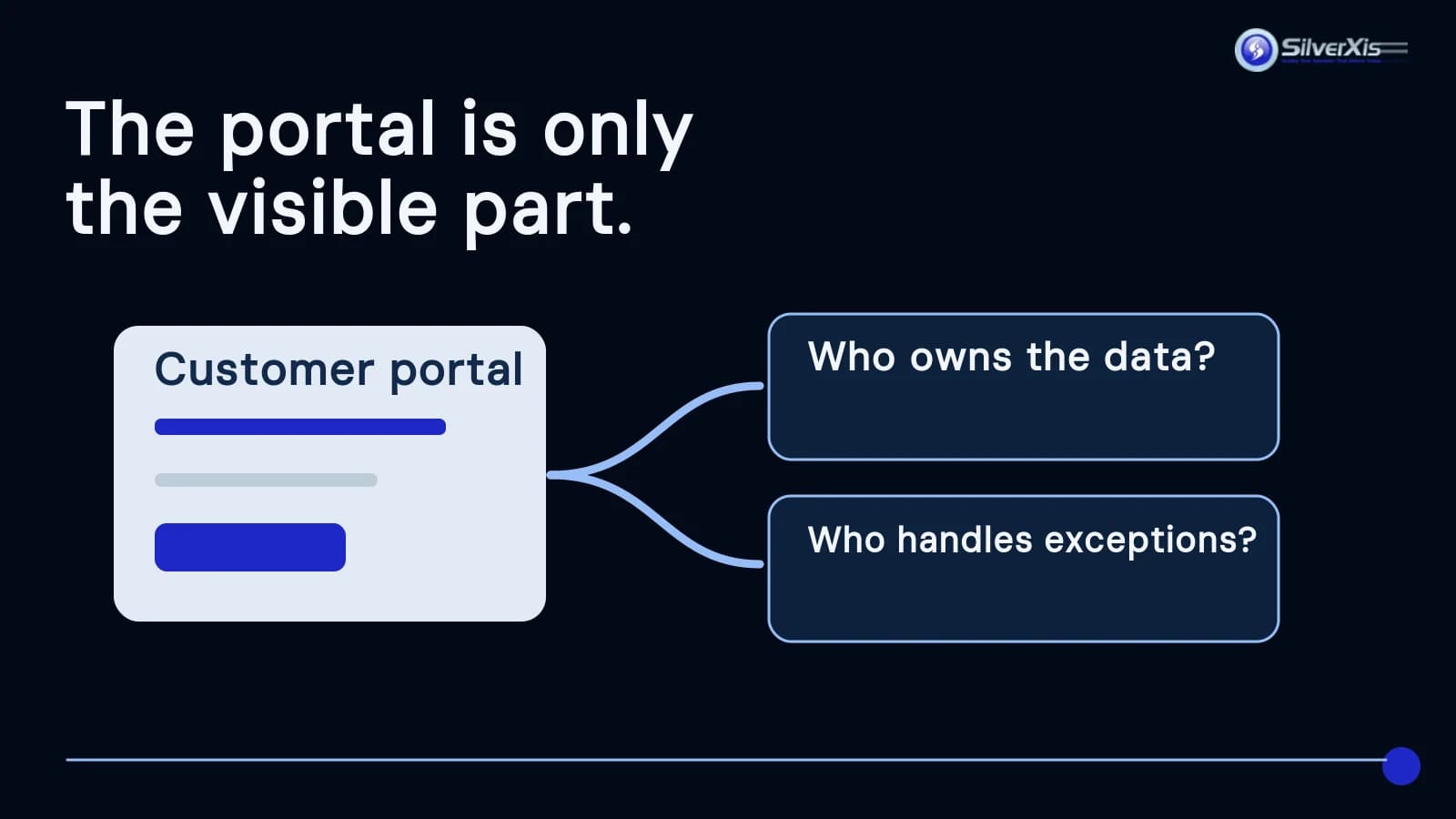
Decide who owns the status
before designing the screen.
Source
Authoritative data
Status
Who updates it?
Exception
Who resolves it?
Records, statuses and exceptions need named owners before development.
Find the smallest complete customer journey
The temptation is to build every possible portal feature at once. That sounds efficient when procurement is comparing proposals. In reality, each additional feature can introduce another record, permission or approval. A narrower first release is often easier to evaluate and easier for employees to support.
The passport service presents an understandable sequence: confirm eligibility, submit an application, receive status information and respond if more details are required. A business shouldn’t copy that sequence blindly. It should identify its own recurring request and follow it from the customer’s first action through the employee’s final resolution.
For a distributor, the request may be an order status inquiry. For a service business, it may be the status of an open job. Select one real journey, establish which information it needs and decide how to handle the cases that can’t be answered automatically. If nobody can describe the journey end to end, the scope is not ready to price confidently.
Our position at SilverXis is to start customer self-service with one recurring request and the records behind it. We favor connecting existing systems when that is enough, and building custom software when the business process truly requires it. The decision should be visible in the plan, rather than appearing as an unexplained cost later.
How should you compare customer portal proposals?
Two vendors can show similar page designs and propose very different work. One may include data integration and an exception path. Another may assume the customer will enter everything manually while employees continue reconciling records behind the scenes. Both could technically provide a portal. They won’t produce the same operating experience.
Ask each vendor to show where the information comes from, who maintains it and which conditions remain outside the first release. Request a demonstration of the ordinary journey and the failed or incomplete one. A proposal that identifies these limits is easier to evaluate than a beautiful list of features with no account of what happens after submission.
The comparison that counts: Evaluate which proposal covers the whole selected customer request, including its exception path, before comparing the number of screens.
The State Department’s renewal service is a reminder that the customer’s interface must be backed by decisions about eligibility, records and follow-up. For your own project, those decisions should come before a development estimate. Start with SilverXis Custom Software Development Services and choose Map My Solution to define the journey, the owners and the scope before construction begins.
What should you decide before building a customer portal?
Which customer request it handles first, which system holds the authoritative record, who corrects a wrong status and how exceptions reach a person. Without those answers, developers end up making business decisions by default.
Who should attend portal discovery?
The person responsible for the source record, the person who handles exceptions and the person accountable for the customer experience, along with sales and the technical team.
How do you compare customer portal proposals?
Ask each vendor where the information comes from, who maintains it and what is outside the first release. Request a demo of the normal journey and of a failed or incomplete one before you compare screen counts.
About the Author
Caleb Odom Director of Partnerships
Caleb Odom is Director of Partnerships at SilverXis. His business-development work spans custom software, IT staff augmentation and digital marketing. He helps organizations examine their needs, understand dependencies and evaluate potential approaches. His perspective centers on how stakeholders make buying decisions and connect a service investment to a useful business outcome.
No commitment required · Response within 24 hours · Free discovery call
We use cookies to understand how our site is used. Necessary cookies keep the site working. With your permission, we’d also use analytics cookies to improve it. You can change your mind anytime in Cookie settings. Cookie Policy